tough business:
a parker site
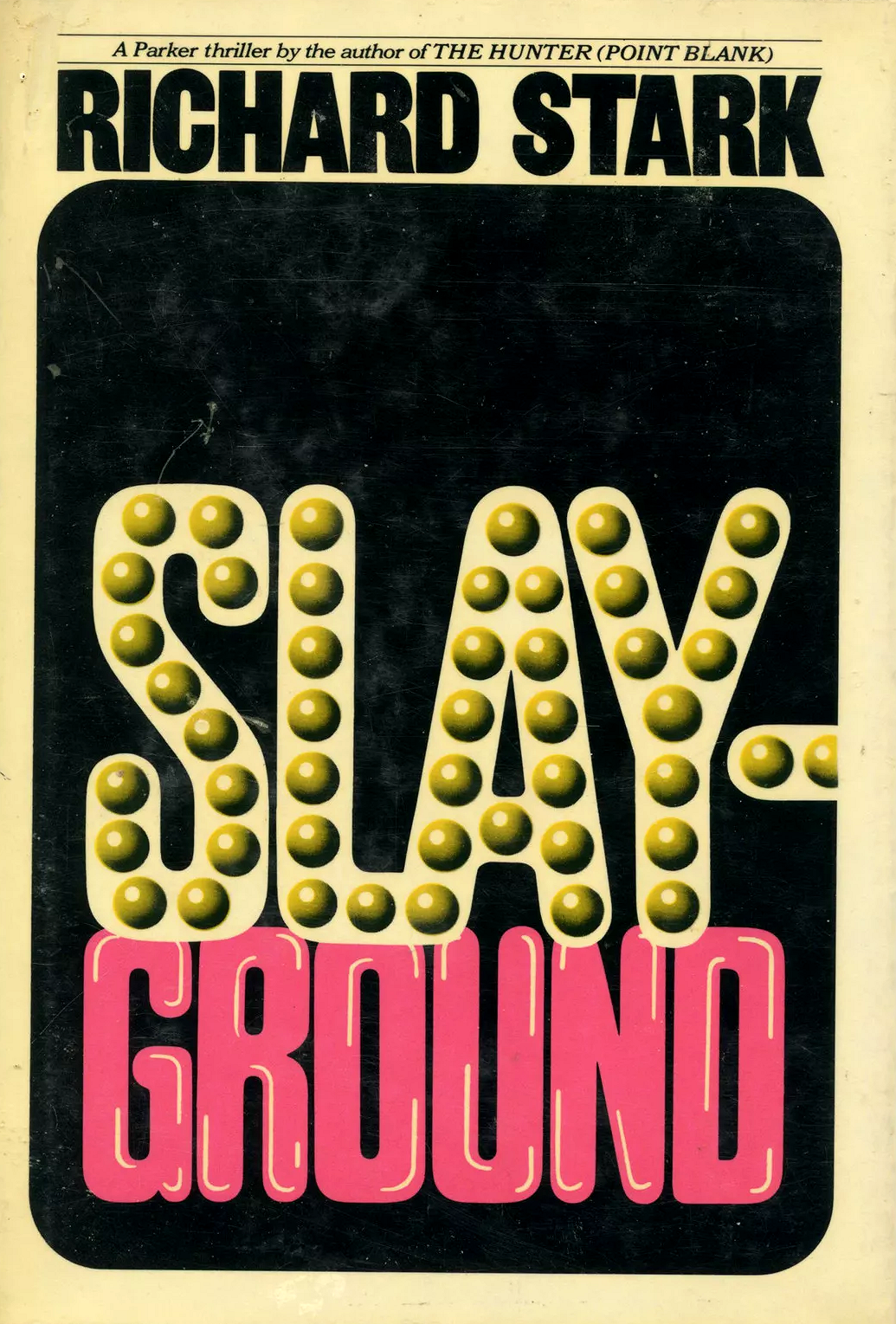
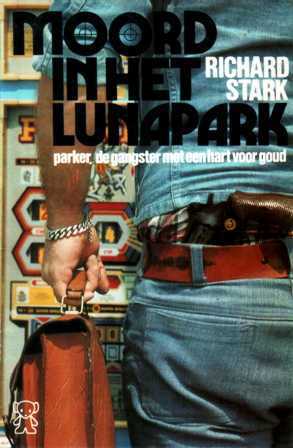
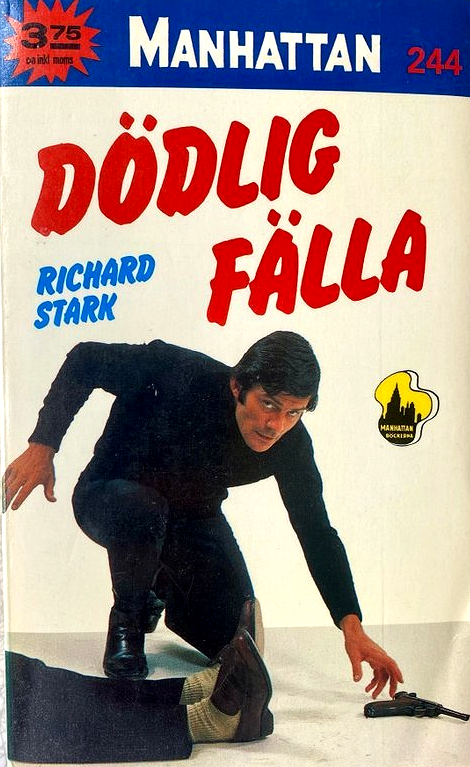
Slayground
Published: 1971.
Cover Artist: Peter Rauch.
Publisher: Random House.
Cover blurb: "Parker had the money. Now he was trapped and the mob was closing in..."
Synopsis: Stuck in an amusement park after a failed getaway, Parker has no choice but to turn it into a death trap for the men trying to steal his latest score.
Adaptations: - Slayground (1983), directed by Terry Bedford and starring Peter Coyote.
- Richard Stark's Parker: Slayground (2013), graphic novel by Darwyn Cooke and published by IDW.
Notes: - First chapter shared with The Blackbird, seen there from Alan Grofield's point of view.
Gallery:
Review:
In 1969, Richard Stark wrote The Blackbird, a twist-filled novel of international spy intrigue, told from the viewpoint of Parker's frequent partner in crime, Alan Grofield. Two years later, out of The Blackbird came Slayground, the 17th novel in the series. The two share a first chapter: a job goes wrong, one man ends up dead, and our two protagonists are separated. Slayground lays out the other side of the story: Parker ends up trapped in an amusement park with the Outfit trying to track him down.
Like the majority of Parker novels, Slayground deals most heavily in subtext. Stark's output had always had an undercurrent of experimentation, the books remain so tight and exciting to this very day for this exact reason, but the nature of his literary experiments had changed over time. The early half of the series tends towards genre changes (The Jugger features Parker trying to solve a mystery, The Seventh is a revenge thriller, The Handle plays with notions of James Bond-esque espionage), while the latter half constructs a relatively simple premise around one central theme (The Green Eagle Score is about psychology, The Sour Lemon Score explores identity, and so on). Slayground's central theme is aging, and the passing of time.
The narrative is punctuated by deep melancholy notes of nostalgia, unlike its less claustrophobic companion The Blackbird or the other Parker stories Stark had previously written. If anything, it's not Hammett's unsentimental approach that comes to mind but the solitude and sadness of Raymond Chandler's work — as much as Westlake had repeatedly denied any influence on Parker from the latter author. This characteristic comes into play right away in the second chapter, when we're treated to the classic Stark rewind as Parker recalls buying the heist plan from Dent, a retired old man who'd once been in this line of work.
Dent reminisces about the jobs Parker had pulled with Handy McKay, about Joe Sheer, and talks about how his "elevens are up". It's an old superstition that Parker at first denies, then suddenly comes around to — "when the number eleven shows in the tendons on the back of a man's neck, he's finished, everybody knew that. Parker didn't waste time trying to lie to the old man." Still, he indulges Dent in conversation, he stays for tea, Parker makes allowances he wouldn't have made a few years prior.
One of the most remarkable things about Slayground is how much space it permits for Parker's emotions. Once he's scouted out the amusement park he's trapped in, he takes a brief respite in the night watchman's office and resumes Dent's reminiscing. It's the first time in the series Parker's ever sat down and thought about everyone he's lost, previous jobs and old friends and the traumatic time he'd spent in prison. It's a moment that goes against every facet of the common perception of Parker, and yet Stark had been subtly fighting those beliefs for a number of novels now. Here, it happens in plain view. Parker's feelings aren't understated, his nerves and fears are spelled out: "sitting here thinking about dead people, as though his own life was over now."
His humanity is underlined again and again throughout the novel, on an internal level through nostalgia and wistfulness but also abruptly brought to the surface once the physical strain of his predicament starts weighing on him.
Parker's struggle with Dunstan that causes the two men to plunge into the icy water marks a turning point in Parker's situation — for the worse. He nearly passes out on impact, and even making it out of the water is a struggle. Losing his gun is the most obvious repercussion, but more than that, Parker starts to feel his age by the way his body reacts to the condition it's in. He thinks about needing time to recuperate from the exertion, something that he wouldn't have needed nearly as much earlier in the series. The next morning, the state of his body is downright disconcerting: "he was in rotten shape to survive, stiff and creaking like an old man from the combination of being soaked in icy water and then sleeping on the floor in an unheated room. His joints cracked when he moved, every part of him ached."
These aren't the effects of a gunshot wound, of a no-holds-barred fight, but it's also not the body that had shrugged off nearly bleeding out from a bullet to the gut in 1963's The Mourner. Parker has aged, and Stark proves he's still got it but the novel's rarely-acknowledged theme is emphasized at every turn. Parker's desperate to survive, and he's determined to do so, but he has to contend with the reality of what used to be the most reliable tool for the job — his body.
The physical goes hand-in-hand with the psychological. Adding to the novel's unprecedented interiority and its air of melancholy are Parker's thoughts on his relationship with Claire, or rather lack thereof. We're informed early in the book that "it didn't occur to him to call Claire. [...] He would either get back to her or he wouldn't." In the finale, her existence is presented as an intrusion into Parker's life, a departure from "rationality." Parker's thoughts on companionship, and his own potential need for it, are another aspect of his newly-showcased humanity. He's grown more certain of his identity with age.
Slayground also occupies a unique place within the Stark canon because it's so deeply connected to two other entries in the series. The Blackbird is obvious, but Slayground also sets the scene for Butcher's Moon, the magnificent series finale that had so decisively framed Parker and Grofield as co-protagonists. Interestingly, Lozini's speech in this novel foreshadows Parker's own speech in Butcher's Moon, and it's also Lozini who explicitly recognizes that capacity for emotion in Parker when he later realizes he's not the "ice-eyed robot" he'd thought of him after their first meeting. Slayground is Stark's boldest character study, and a vital step in Parker's development as the series heads towards its climax.