tough business:
a parker site
"Golden Androgyny" – Homoerotic Subtext in Point Blank (1967)
If Richard Stark’s Parker series paved the way for a new era of crime literature, then Point Blank announced the arrival of the neo-noir. The film is surely the best-known adaptation of Stark’s novels, and has become a legitimate classic in its own right – compellingly caught between European arthouse influences and the rigid conventions of the Hollywood-perfected noir. Point Blank, like the Parker books, does some of its best work in subtext though.
In writing for the British Film Institute’s series of books analyzing a variety of cinematic landmarks, Eric G. Wilson highlights this subtext at the heart of the film and frames it as necessary to any understanding of the story being told. The following text is Chapter 8 of BFI Film Classics: Point Blank.
Chapter 8: Golden Androgyny
"If there is in Point Blank an episode showing Walker breaking out of type, it occurs right after his scuffle at the jazz club. Bruised and battered, he arrives at Chris's apartment. Unlike the other buildings in Boorman's LA, its exterior is made of wood, and it's surrounded by trees. An experienced thief, Walker breaks in easily, takes out his gun. We are on the verge, it appears, of a repeat of the break-in at Lynne's apartment. Maybe Mal is here. Will Walker rush to the bedroom and open fire?
He does enter the bedroom, and he finds a woman sleeping there. He tries to wake her, but she's out. Dead like Lynne? He turns on the bedstand light. Flowers decorate the shade, and above the bed hangs a piece of modern art, rich in yellows, golds, creams and browns. The wall itself is honey yellow. This is not the ghostly dwelling of Walker's dead wife. But is it just as tragic? Walker finds a pill bottle beside the bed. He sits on the edge of the mattress and tries to rouse the woman again. She wakes up, groggy. 'Walker,' she says, gently. It's Chris, and she is not afraid.
Walker gets to the point. 'Where's Mal?' His voice is hard. Not quite cognisant, Chris ignores the question. Drowsily, she tells Walker he's 'supposed to be dead'. No, he says, Lynne is dead. Pills. He slaps the bottle off the bedstand with the barrel of his .44. Chris says she's not been sleeping.
If you care about Walker's character by this point in the film, the next lines are heartbreaking. Walker says he's heard that Chris is with Mal. 'No’, she replies. 'Why don't you want him?' he asks. She answers: 'Because he makes my flesh crawl.' 'I want him,' Walker says. Then, in a film of brutally efficient dialogue and dead-eyed stares, an exquisitely delicate line rises, uncalled for, tangential, uttered by a woman vulnerable in her sleepiness, wearing a soft white T-shirt, but also sexy, relaxed and welcoming in her bed. Chris says, 'You were always the best thing about Lynne.'
In that sentence exists an alternative universe, as far from criminal LA as Lynne's sterile little palace is from Chris's pastoral interiors. The sentence implies that Walker had affectionate relations beyond his treacherous wife and friend. His sister-in-law liked him. And why not? From what we saw in Walker's first encounter with Lynne, he was loose, gallant, tender, handsome.
It's not only what Dickinson's Chris says to Walker. It's how she says it. So spontaneously, casually, with no ulterior motive, nothing to gain. This in a world where everyone's out for something, trying to reduce you to a means for their furtherance.
In confessing to Walker that he was the best thing about Lynne, Chris offers him succour that he has not experienced, at least since he was shot. And how does Walker respond? He doesn't. As if Chris said nothing, he asks why she doesn't want Mal. He is paranoid. All women, especially the sister of his unfaithful wife, are surely bent on betraying him with Mal. Mercifully, Chris doesn't show any disappointment over this implied accusation. She tells Walker that she doesn't want any member of the Organisation. This outfit killed her boyfriend, took over his club and forces her to run it. She says that she loved her boyfriend. To which Walker, like an automaton unable to understand basic human feelings, replies, 'Why?' Alert to his emotional stupidity, Chris answers in kind: ‘Hey, gotta make a living.’
During this conversation, Walker has sat on the edge of Chris's bed. The camera has hovered just over his shoulder, looking down at her. The effect falls somewhere between a point-of-view perspective and a more objective one. It is a relief to feel that we aren't limited solely to Walker's angle. There is room for expansion, both for the audience and maybe for Walker himself. If anyone can lift Walker out of his tormented ego to see through someone else's eyes, it is Chris.
***
The next cut is harsh: the Organisation's Wilshire Blvd high-rise office building, filmed from a low angle, blinding white, redundant window patterns chopping its concrete into immense prison bars. As the starkness offends the eye, unseen engines (jackhammers?) trouble the ear. In terms of plot, the brief scene that takes place within the building is inconsequential: Stegman reports to a furious Mal that Walker lives. We already know Walker escaped The Movie House, and we would assume that Mal would be incensed. Why did Boorman include the scene? To contrast Chris's organic abode with the Organisation's ominous artifices.
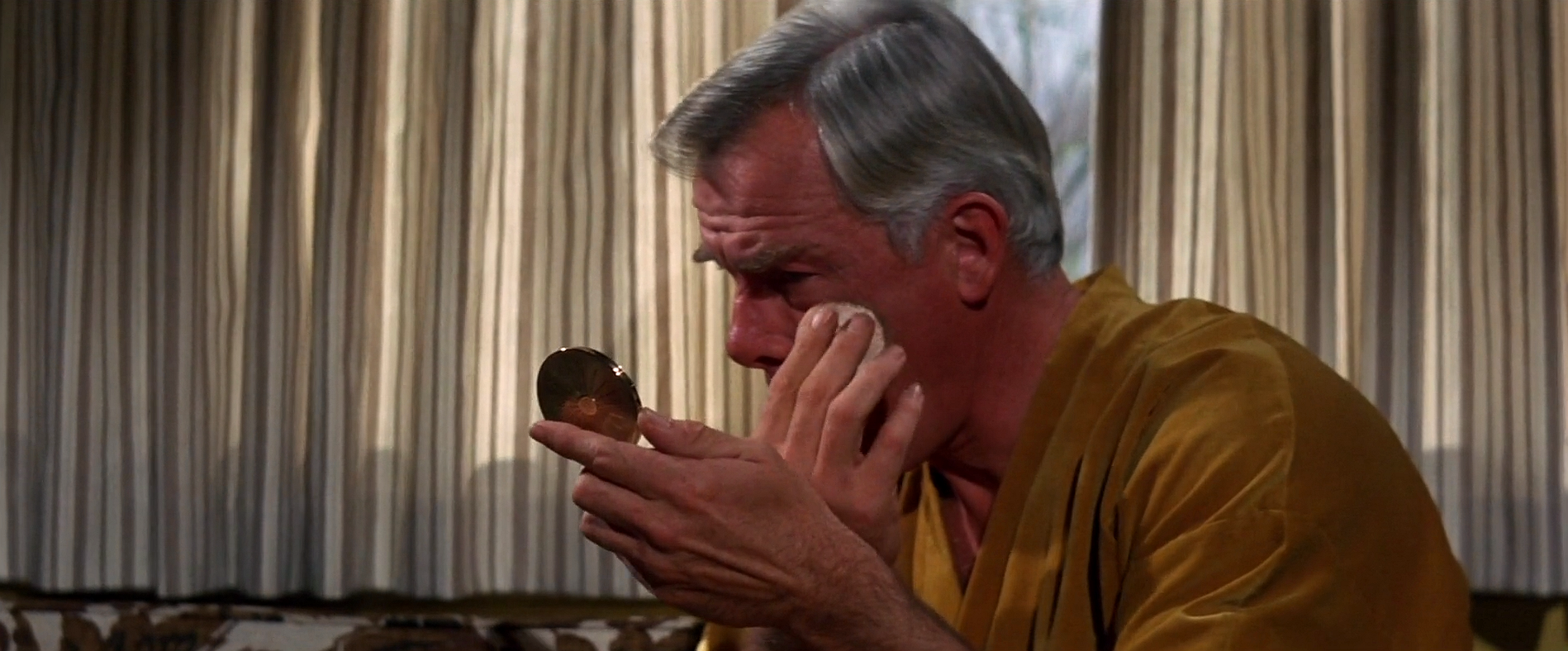
In twenty-three seconds, we are back in Chris's apartment and... what seems a different movie. It is morning, and Walker is lounging in a golden robe, and nothing else. Perhaps it's a robe that belonged to Chris's departed lover, but it could well be hers. Well, why wouldn't it be hers? Walker appears to be going full female. He's putting on make-up. Trying to cover a bruise below his eye. The look on his face is whimsical, and he is 'toying', the script says, with the compact case. Any minute he might become Cary Grant in Bringing Up Baby (1939), who, while donning a flouncy robe when his clothes are being cleaned, whoops that he's just not himself today.
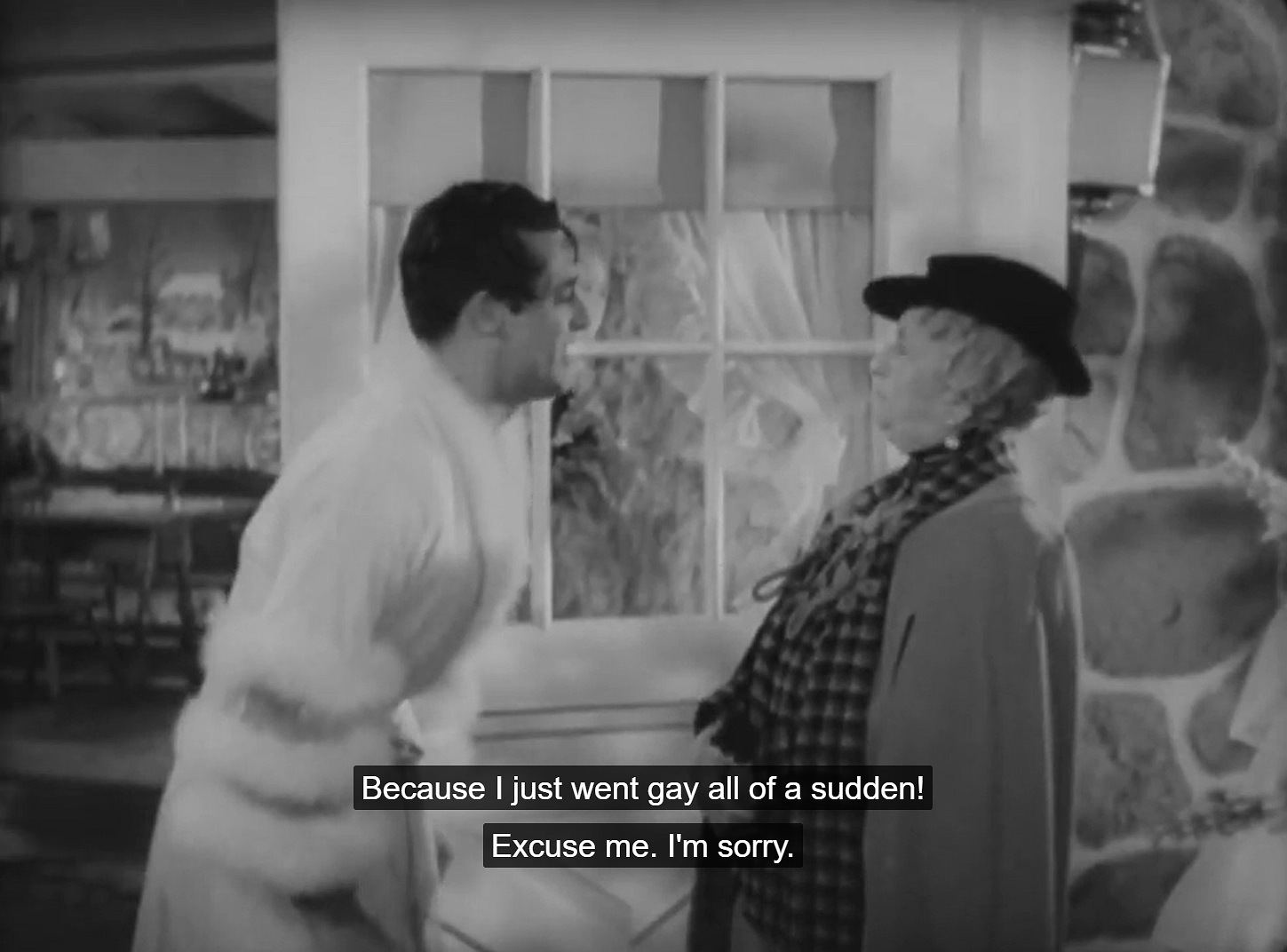
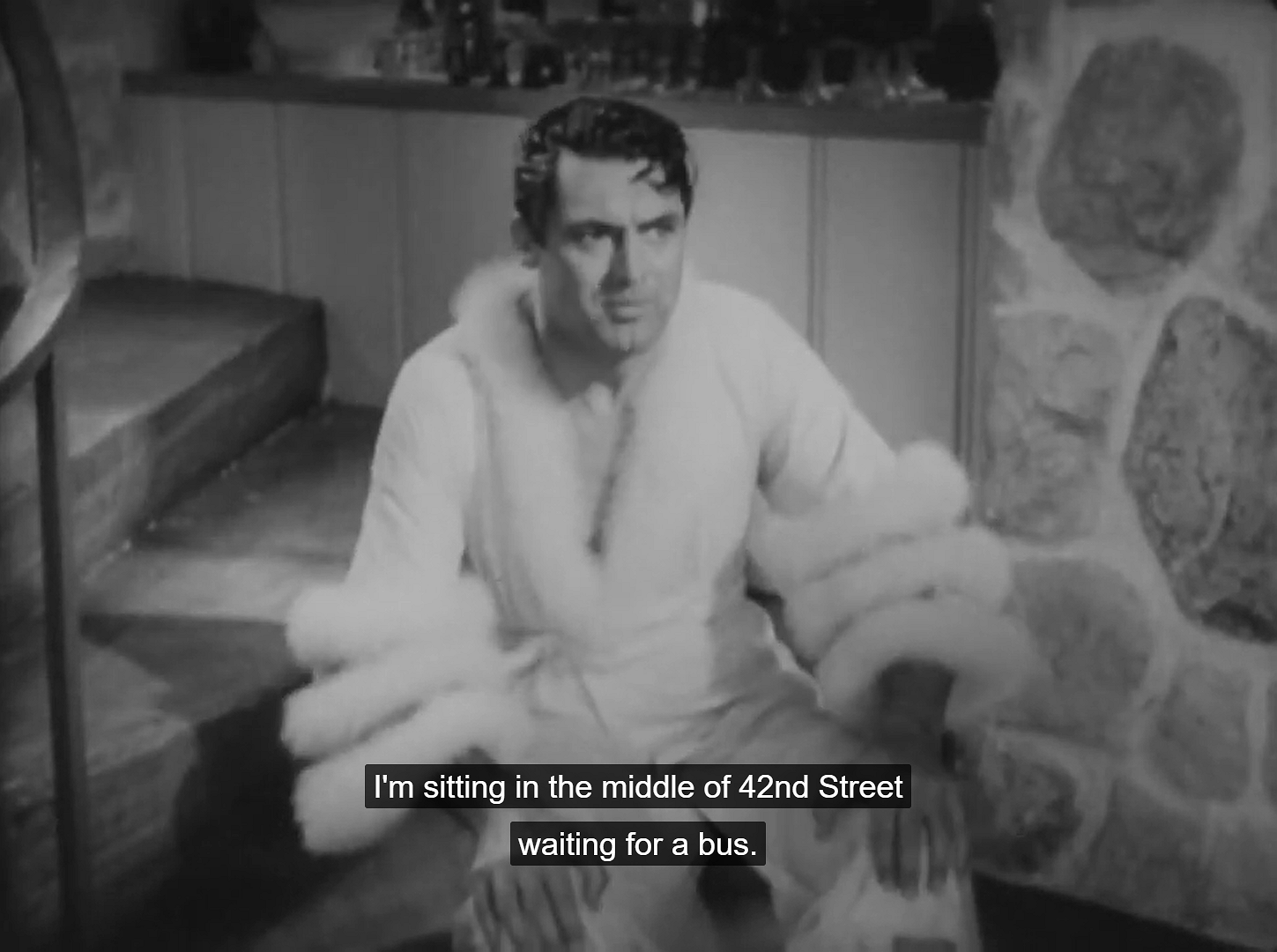
How did this happen? Has Chris's house relaxed Walker back into his old playfulness? Has she led him into an alternate world where his trauma never occurred? Has she inspired a new identity?
Up until now, Walker has worn only tight, creaseless suits (Boorman wanted them to resemble body armour), and his face has barely cracked into any expression. Now he's loose. His privates might flop out at any minute. Maybe he's tired of performing traditional manhood, with its violence and greed. He's seen how absurd it is to sacrifice the dishevelled frolic of life to the geometries of power. He's ready to cultivate that part of himself the vicious world of men has left him almost bereft of, that part that Boorman observed in Marvin himself: as 'tender… as a woman's... to the wounds of the world'.
But these explanations are so serious. Maybe Walker threw on Chris's robe just for the hell of it, and he likes how it feels on his skin, and that bruise looks pretty nasty, so why not grab that make-up kit and hide it?
Regardless of Walker's reasoning, the scene is amiably domestic. It's as though Walker and Chris are married. In her lush golden dress, Dickinson scurries around the apartment gathering things for work. Art hangs on the warm honey walls and the surfaces of the wooden furniture teem with knick-knacks. A tall shelf filled with books covers one wall. An array of hats decorates the wall at the bottom of the stairs.
The scene could indeed be from a Hawks screwball comedy, or maybe a Hudson/Day romcom, or even one of Nick and Nora's Thin Man movies (1934-47). After enduring Boorman's cruel wastes, we are glad to lounge in this soft, fertile, inconsequential world.
Then, just like that, Walker locks back into auto-mode: get my money, get my money. To Chris's pleasant reminder that they'll meet at noon – as if they have a romantic lunch planned – Walker, in his calloused baritone, booms, 'Don't get lost' – meaning, don't duck out on me, make sure you help me get Mal. Chris is offended. She sensed a softening in Walker, and she responded in kind, and now he's returned to his egotistical quest, and rejects her affection.
***
Boorman cuts again to the Organisation's Wilshire high-rise. This time, he shows the interiors, which might be offices in Mad Men (AMC, 2007-15). This is crime as everyday corporate capitalism, which means that the Organisation conceals its nefarious dealings (under the name of Multiplex Products) extremely well, but also implies that all corporate capitalism, in viewing humans solely as units of getting and spending, might be criminal.
Mal waits to see Carter (Lloyd Bochner), his superior. He needs help eliminating Walker. Typewriters, ringing phones, professional murmurs are in the background. A smartly dressed receptionist calls Mal back. On the way to Carter's office, Mal is frisked - just routine. And then into Carter's all green room: walls, carpet, phones, intercom, desk, suit, briefcase, chair, couch. The colour is both ironic - this world opposes the organic and accurate: it is diseased. The decor, highly artificial and minimalist, is cold as death. Carter is the blandest crime boss imaginable: an efficient businessman giving a wayward employee, Mal, a self-satisfied talking-to about his unsound method and proposing a more efficient one. Let Walker know where Mal is, and he will come for him, and we will eliminate Walker.
While Mal takes his dressing-down, Walker hovers between his traumatic repetitions and new possibilities. He sits on a curb stop in a parking lot. Behind him is Ocean Ave in Santa Monica, behind which is a bluff lined with pine trees. The ocean is beyond. Walker wears a golden-rust shirt and a lighter golden tie, with a brown houndstooth coat. These colours suggest vitality, as does the ocean.
Chris in her lovely honey-yellow dress sits down beside him, and we recall her exuberantly golden world, and realise: Walker is dressing like she does. He wants to be a part of her world. (That Walker never carries a suitcase but wears a variety of elegant well-tailored suits is part of the film's dreaminess.) She's been out gathering information, and she tells him of the Organisation's plan, the setup.
Chris and Walker spend the afternoon figuring out how to sneak Walker into Mal's penthouse in the Huntley Hotel. Walker once more plays a more traditionally feminine role. Chris drives his black station wagon - now more suggestive of a family car than a hearse - while Walker is the passenger. They gaze up at the Huntley, its glaring white concrete the same as that of the Wilshire building: pitiless, impenetrable. Organisation men are everywhere.
Their recon over, Walker and Chris once more position themselves near the shore of the Pacific. Walker stands beside a bright yellow coin telescope pointed towards the sea. Put in your dime, gaze at the waves. Walker wrenches the lens towards the Huntley. The lock pops with a satisfying 'ping'. He bends down to the level of the eyepiece and studies Mal's lair.
Boorman intercuts between Walker seeing and what Walker sees. One shot is the most compelling of the film: a medium shot of Walker from head-on, the yellow viewfinder covering his face, his body leaned casually back against a waist-high chain-linked fence, the Pacific coruscating in the distance. As with the scene when Walker applies make-up while wearing Chris's robe, this intimates another life. The yellow of the telescope is daffodil, a perfect complement to Walker's golden-rod garb, and the ocean is blue plenitude. All Walker need do is turn around and contemplate the expanding azure. Then what? Through the festive yellow, he might perceive as Chris does, become attuned to play and spontaneity (she is a jazz fan), and he might realise that there are no perfectly straight lines in nature but eddies and waves. He might celebrate his own lively mixes of flux and form.
But Walker keeps his eye on the building, and on his quest, and, worse, uses Chris as a tool to get his money. He asks her how bad Mal wants her. Pretty bad, she admits. Bad enough, he wonders, to let her into the Huntley?
'Why should I?' Chris, angry, asks.
'Well, that's up to you.'
Chris hesitates. But she agrees. She will convince Mal to let her into his penthouse by giving him the impression that she will have sex with him. Once inside, she will unlock the balcony door for Walker. To make the plan believable, she must be willing to go through with the sex, even though Mal makes her flesh crawl. What if Walker doesn't get into the room soon enough? She will have whored herself out for a man she barely knows so he can (possibly) get money that he stole in the first place.
Alexander Jacobs was concerned that audiences wouldn't find Chris's decision convincing. He said a strong intimacy between her and Walker must be established for her choice to make sense. To Jacobs's chagrin, this did not happen, at least not overtly. But the affection is implied in Chris's delicate welcome of Walker into her life, a welcome that awakens desirable traits long latent in the man – offbeat charisma, alluring vulnerability.
But Chris probably has other reasons for going along with Walker's scheme. Maybe she feels guilt for what her sister did to him. Maybe she herself wants Mal to go down.
Perhaps Chris teams with Walker, though, for no clear rationale. She agrees to the plan simply because she agrees to the plan. As we know, Boorman's minimalist, fragmented film often leaves out explanations for why things happen. Why does Walker wear a different suit in almost every scene? Where does he sleep? How did he survive his wounds? We don't know, can't know. The mystery applies to Chris's choice. We can surmise why she does it, but we can also say, she simply does it.
And isn't this how so much of life is? Things happen because they happen, and after the fact we try to account for why and how, and we might come up with valid explanations, but we can never know if they're valid once and for all. Does this mean we stop trying to explain? No. We need explanations. But do we settle on one interpretation? No. The world's too inscrutable. At so many junctures, Point Blank puts us in this troubling yet generative tension between 'that's it' and 'maybe not'.
On Walker's behalf, Chris enters Mal's keep. Night has come, and she wears a golden wool trench coat cut just above the knees. In the lobby of the Huntley the men leer at her. She rides the elevator up.
Meanwhile Walker stands in an apartment window across the street from Mal's building. He has coerced the two inhabitants, seemingly a gay couple, into tying each other up. They will call the police and report being attacked. The police will arrive and divert Mal's guards, and Walker will slip through.
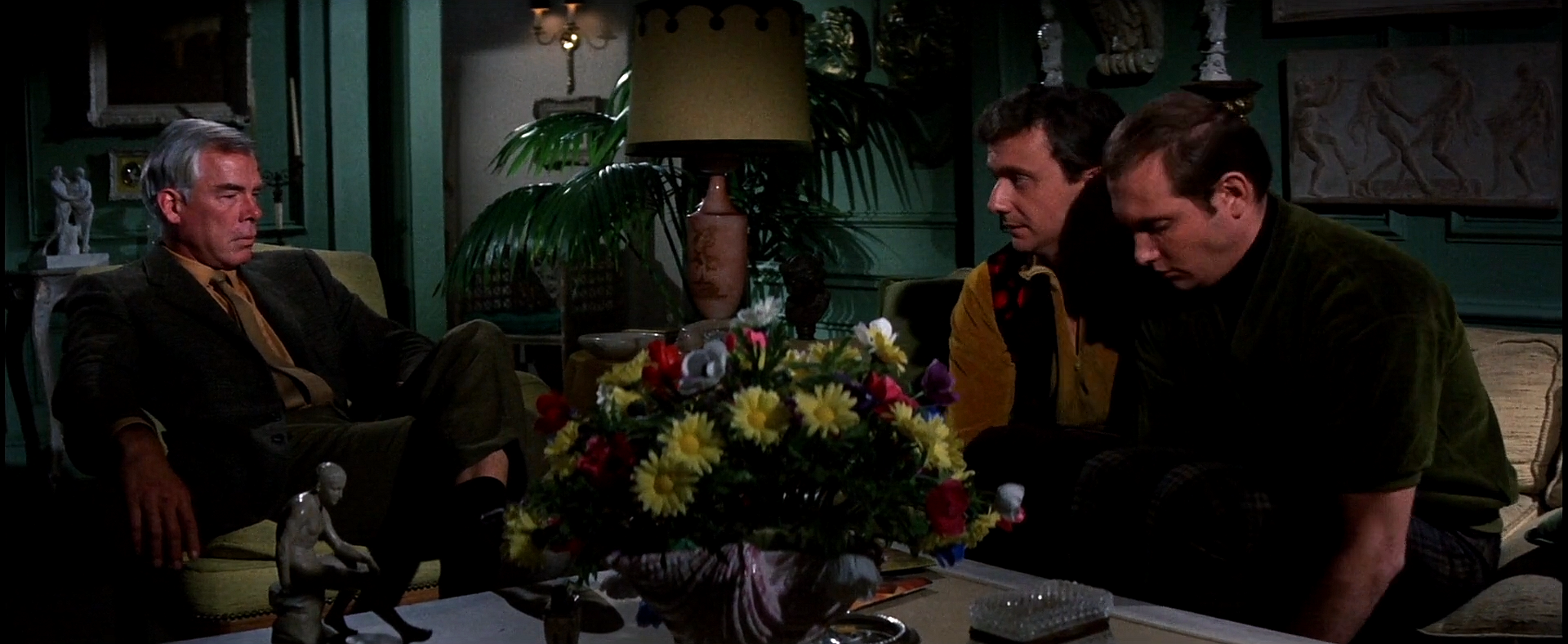
Walker's interactions with the couple are funny. He lounges in a chair, and the two men relax on the couch. It's like they've been casually chatting. When Walker impassively asks them to tie each other up, they do so almost willingly, like they are trying to please their captor. The same is true when one of the men calls the police and reports terrible danger. The other man asks, 'Is that alright?' A deadpan Walker says, 'That's fine. Thank you.' He leaves. The men look at each other excitedly. The whole sequence feels more like broad comedy than suspense.
Not so in Mal's penthouse, where Chris finds herself in a dark fairytale, pitting her nature magic against Bluebeard. Mal's world is crimson: carpets, walls, pillow, robe. Unaware how gross and creepy he is, Mal fashions himself a red-hot lover. When Chris arrives, he stands in his bathroom wearing only brown slacks. He is flabby and hirsute. Soft jazz plays on the stereo. 'C'mon on in, honey!' he says, trying to sound authoritative and seductive. He emerges from the bathroom in a too-tight mustard-coloured velour shirt, pours Chris a scotch, and demands that she travel with him to New York. Right after the two sit on the couch, he opens her dress (yellow, again, with golden stripes, a honeybee look); but before he can remove her bra, she hugs him, defensively. Sensing Mal's disappointment, she removes the belt around her dress. Mal grins in ogreish lust.
A siren sounds.
If Mal's efforts are stomach-turningly awkward, Walker's are the opposite. As Mal's guards scramble to figure out why all these cops are showing up, Walker strolls into the Huntley with disarming nonchalance – Marvin, once more, at his most Marvin. Chris has stealthily unlocked the sliding-glass door leading onto the balcony. Without us even seeing, as if he did it effortlessly, Walker has tied up the balcony guards. Mal has got Chris into bed, she's wearing nothing but her slip, and he's getting ready to make his final move – when under the curtains covering the balcony door a hand appears, and it silently lifts the fabric, which bunches like an accordion, and then the .44 emerges. Walker. He passes through. Chris sees him and Walker puts his hand gently on Mal's shoulder and puts his gun to his old friend's head and Chris slaps Mal and screams, 'Get off!'
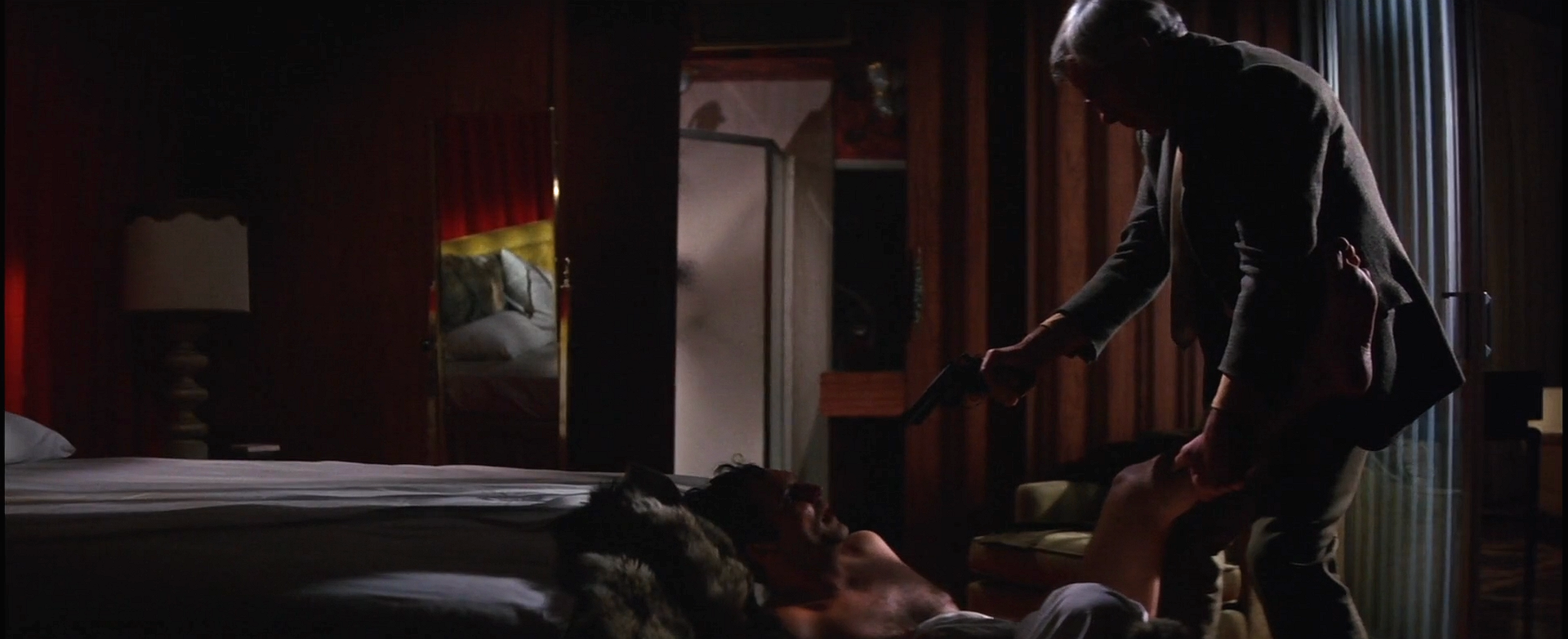
Walker grabs Mal, still wrapped in his sheet, and drags him to the floor. Walker then clutches the sheet right at Mal's chest and pulls him up. While Walker interrogates Mal about the money, Mal continually falls and Walker jerks him up. Mal is sweating, he can't remember anything. He begs to put his clothes on. Nothing doing, Walker says, you're going with me right now, to see Carter and help me get my money. Walker guides the sheeted Mal onto the balcony; they're going to take the service elevator. 'I'll get your money,' Mal says. "Trust me!"
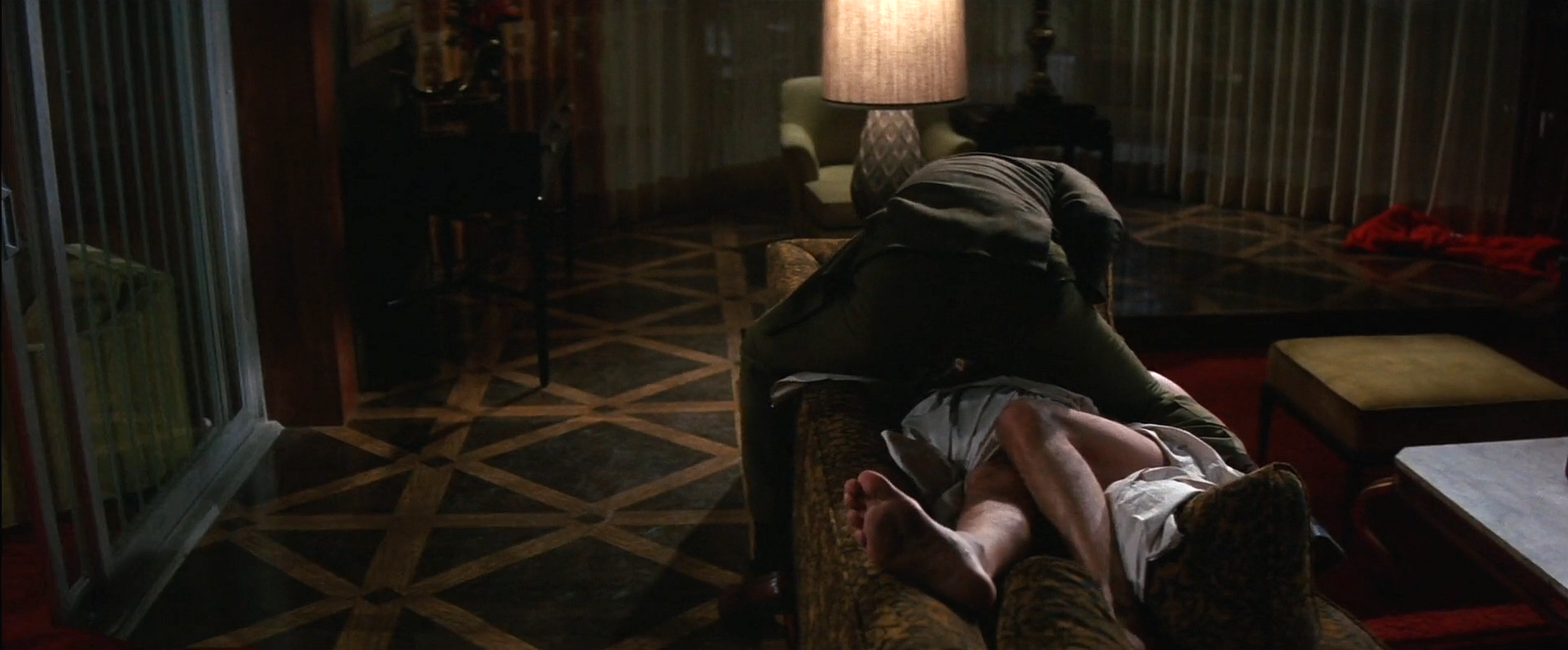
This moment is sexual – the way Walker leads the naked Mal around by a sheet bunched in front like a phallus. The early shots of their wrestling on the floor of the party, of Mal looking sexually aroused after shooting Walker, of Walker showing more interest in Mal than the seductive Chris: these all suggest a homoerotic relationship. Not that the two men were lovers. Boorman illuminates the eroticism of violence: in the hypermasculine world of criminalised capitalism, the intimacy of inflicting pain on another man satisfies more than the love embrace.
Walker's (figurative) lovemaking to Mal suffers a coitus interruptus: a flashback. The film cuts to the early moment when Mal tackles Walker to the floor and screams 'Trust me… you're my friend, Walker, my best friend!'
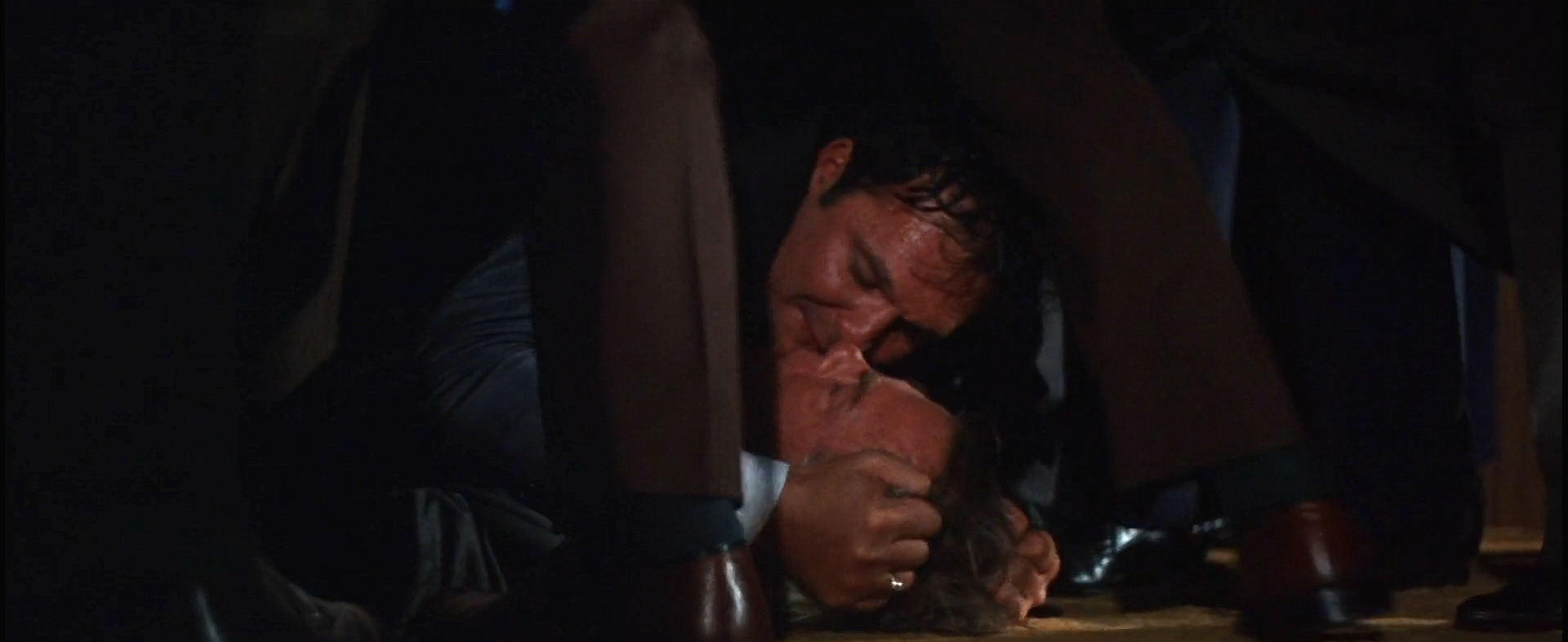
Back in the present, Walker falters. 'You… you ...' he stammers. But he recovers fast. He tells Mal that they'll do it together this time, they'll go to Carter, they will get the $93,000.
A light flips on back in the room, and someone calls 'Mal!' It is one of the guards who was standing outside the interior door.
Walker jerks Mal further out onto the balcony. Mal uses the momentum to unravel from the sheet and he falls over the ledge naked and is killed.
With cops now swarming the Huntley – what caused the naked man to fall? – Mal's guards are even more preoccupied, and Walker exits as smoothly as he entered. He finds Chris on the street, tells her Mal fell. Chris is shocked. He fell? 'You should've killed him. You owed it to yourself.'
As if she said nothing, Walker produces the $1,000 that he took from Lynne's delivery boy and says, 'This money belonged to your sister; you'd better take it.'
Offended, Chris replies, 'You died at Alcatraz all right. Goodbye Walker.' Walker barely hears her. He's picking up the payphone to call Carter's office.
Walker is dead to Chris because he didn't want to take revenge on Mal. Even if vengefulness isn't the noblest of human traits, at least it is understandable – if you hurt me, I'll hurt you back – and it is passionate. Some might even believe that revenge is a rough vehicle of justice. But to be indifferent to those who have grossly wronged you – this is inhuman, a psychopathic numbness.
Vengeance would not only have humanised Walker; it would have rendered Chris's sacrifice more meaningful. She risked rape so a man could get $93,000. Now, in offering her Lynne's money, Walker's implied she's a prostitute. This is your fee for seducing Mal.
If Walker showed signs of coming to life earlier in the day, he's now reverted to his hard-as-nails persona, even if he still wears the gold and brown suit that matches him with Chris. The flashback of betrayal that he suffered while he was frisking Mal – this numbed his heart. In once more enduring Mal's villainy, he behaves like Mal. If being a victim is terrible, then being an oppressor might be the opposite, so why not be like the oppressor? Why not treat Chris just as Mal did, as an object?"
In fact, Wilson isn’t the only film critic to have pointed out the homoerotically-charged Walker-Mal dynamic, nor Boorman’s subtle play on gender roles and masculinity – the foreign sight of makeup and a soft robe on a man like Lee Marvin. It stands to reason that Point Blank’s subtext is a reaction to something woven into Stark’s work; even unfaithful adaptations are in constant conversation with the source material, like how Made in U.S.A. (1966) and The Split (1968) respectively use gender and race to underline Parker’s status as an outsider in a visual medium.
The excerpts below were all mentioned in the notes at the end of BFI Film Classics: Point Blank, and serve to form a more complete picture of the film’s homoerotic subtext.
From Jack Shadoian’s Dreams and Dead Ends: The American Gangster/Crime Film (1977, pp. 310-316):
“Walker is played by Lee Marvin, that menacing actor synonymous with nasty force. He is a highly authoritative star, but not an assuring one. His backlog of sadistic, ferocious villains brings an ambivalence to his "hero" role. His viciousness in Point Blank may be justified, but it is also off-putting. It will not do to identify too closely with so frightening a figure. His qualities, moreover, are undercut. He gets chided by the fussy suburbanite Brewster. He is used and tricked by Yost/Fairfax. His primitive directness, the cause of much excitement, is nonetheless futile against an organization that is programmed to correct itself. It is implied that he is homosexual. (In one scene he is oddly feminized by being dressed in Chris's robe and shown powdering his bruises with the puff from her compact.) He dresses conservatively. He has few thoughts and few feelings and speaks few words; he simply follows the scent toward an elemental justice that is finally not to be had.
[...]
Walker, his wife Lynn (Sharon Acker), and Mal Reese are seen as rather ordinary people seduced by life's corruptions. They are lured from their natural paradise of friendship and love by the prospect of a slick, stylish life. All three are beset by guilt, and the disharmony of their sexual lives is their latent corruption brought to the surface. Lynn narrates that Walker "found Mal and brought him home," thus creating a divided loyalty. It is suggested, however, that she is the intruder in the relationship. When Mal goes to shoot Walker in the cell, he pushes Lynn aside. The killing is orgasmic for Mal; he derives a sensual pleasure from drilling Walker.
The flashback (intercut) showing Mal convincing Walker to go in on the robbery is a sexual overture. Mal, at a crowded, noisy convention, throws Walker down on the floor amid a sea of feet and legs and, lying on top of him, implores hysterically for Walker's help – it is a kind of rape. (The flashback of the odd mating dance between Lynn and Walker on the pier is the only sexual attention we see Walker pay his wife, and they are surrounded by a sizable group of Walker's male co-workers.)
Chris, Lynn's sister (Angie Dickinson), becomes for Walker another version of his wife-all women are as-sociated with his betraying wife. Mal, it is implied, rapidly ditches Lynn soon after the robbery and lusts for Chris, who is so like her sister that her conquest would be a repetition of what he stole from Walker and thus indirectly an expression of his longing for the man. (The film appears to be making a statement about the homosexual overtones of male competition.) Chris says that Mal makes her "flesh crawl," a clear sign of sexual revulsion. Walker responds with "I want him." The killing of Reese is sexual, the passive Walker now becomes the erotic aggressor. There is a cut from Reese's hand moving down toward Chris's behind to Walker's fingers edging obscenely upward along the window drapes. When he surprises Reese, Reese demands, "Let me get dressed." Walker insists, "I want you this way," and straddles him. Reese, underneath Walker, begs, "Kill me. Kill me."
The film's sexual perversity is connected to its picture of a systems-dominated world where instincts are warped and sexual outlets and satisfactions are at a total remove from the sexual organs proper. Walker empties his gun into a bed, Reese empties his into Walker.”
From Foster Hirsch’s Detours and Lost Highways: A Map of Neo-Noir (1999, pp. 166-169):
“Doubly unmanned, Walker at the start is hurled into a pit of male anxiety. Throughout his quest, he recalls the moment at a party when his accomplice Mal (the name could be male or female) knocked him down and then straddling him seductively whispered, "I need you." For Walker the event, which he replays in his mind over and over, epitomizes the attack that has been committed against his manhood and suffuses his quest with a lingering homoeroticism that the 1967 film only glancingly acknowledges.
[...]
In the difficult opening, which clearly announces that the film will not play according to crime-movie convention, scenes of Walker's betrayal and "death" at Alcatraz are chaotically intercut with shots of the earlier party scene in which Mal "seduces" Walker.”
From David Thomson’s “A Very Bad Man” published in Sight & Sound (Aug. 2013, pp. 38):
“So in Point Blank Marvin would be Walker, a man – wronged by his wife and his best friend – in whom a terrible violence is freed. He would enlist his wife's sister Chris (Angie Dickinson), and he would love her or couple with her in the way the film's sexual climax imagines all parties in bed with one another. But when Walker leaves his money on the ground at Fort Point, San Francisco, he also walks out on any happy ending with Chris. Whereas Bonnie and Clyde do get shot to pieces, but they have each other in that exquisite shared glance and the shuddering rapture of an orgasm that has been hard to achieve in ordinary life. They go, but they come.
The sexual imagery in Point Blank is so much closer to surrealism. That includes Walker and his wife Lynne (Sharon Acker) in the rain, with that feeling of Walker as a great sea creature who has come ashore to claim her (being in the water is a vital strain in the film). Later on, when he breaks into her house, she is satin-clad but numb. That's when Walker fires his gun into her bed and lets the bullets tumble from his gun in slow motion's spent desire. Later he finds her dead (as if she needed to see Walker a last time before exiting).
More than that, the ties between Walker and Mal Reese (that very suggestive name, played by John Vernon) begin to realise the homosexual attraction that Beatty was famously shy of including in Bonnie and Clyde. That film's scriptwriters, David Newman and Robert Benton, had intended a three-way sexuality with Bonnie, Clyde and C.W. Moss, but Beatty flinched from it. He may have guessed it could hurt the audience and hardly faced how far it would upset him. But Walker and Reese are lovers of a kind. They are seen embracing on the floor in the party scene, and then when Walker comes for his revenge it is rendered in terms of humiliating seduction with the naked Reese dragged from sex and his bed clinging to a sheet that will soon be his shroud. When Walker grabs that sheet and draws Reese to the balcony, he is throttling his privates. Among all the men in The Organization that Walker must climb – Stegman, Brewster, Carter, Yost – there is the sour, gloating hatred of an all-male world. (It's Brewster who delivers the immortal line: "You're a very bad man, Walker, a very destructive man.")
There is a lot to be said about the film’s subtext as response to the novels, and much of it will probably appear right here on Tough Business, but in the meantime, it’s worth recalling that even actor Lee Marvin had made a thinly-veiled reference to Point Blank in his infamous Playboy interview (Jan. 1969, pp. 58), conducted in mid-1968:
“PLAYBOY: Do you think that homosexuality is becoming more prevalent as traditional male-female roles continue to blur?
MARVIN: I certainly see it very heavily on the stage and in films. In fact, I deal in it most heavily. But it's so well disguised that only the ultimate of dissectors would know what I was doing. Let me put it this way: You get up daily and you go to work and do whatever your job is, right? But what does the actor do? He goes into his dressing room and he disrobes and he puts on make-up. Then he puts on a costume and goes out into an area that has a curtain. What normal man would do that?”