tough business:
a parker site
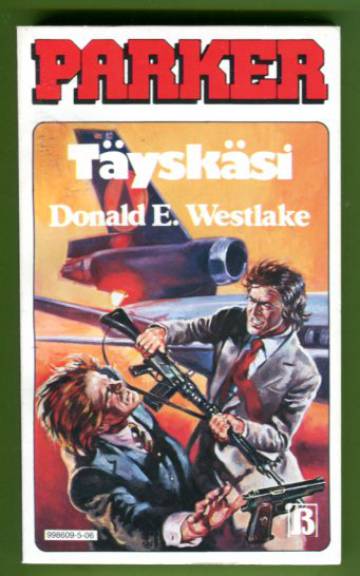
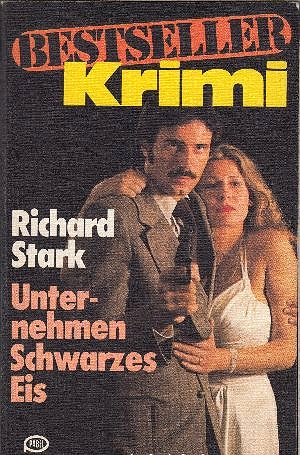
The Black Ice Score
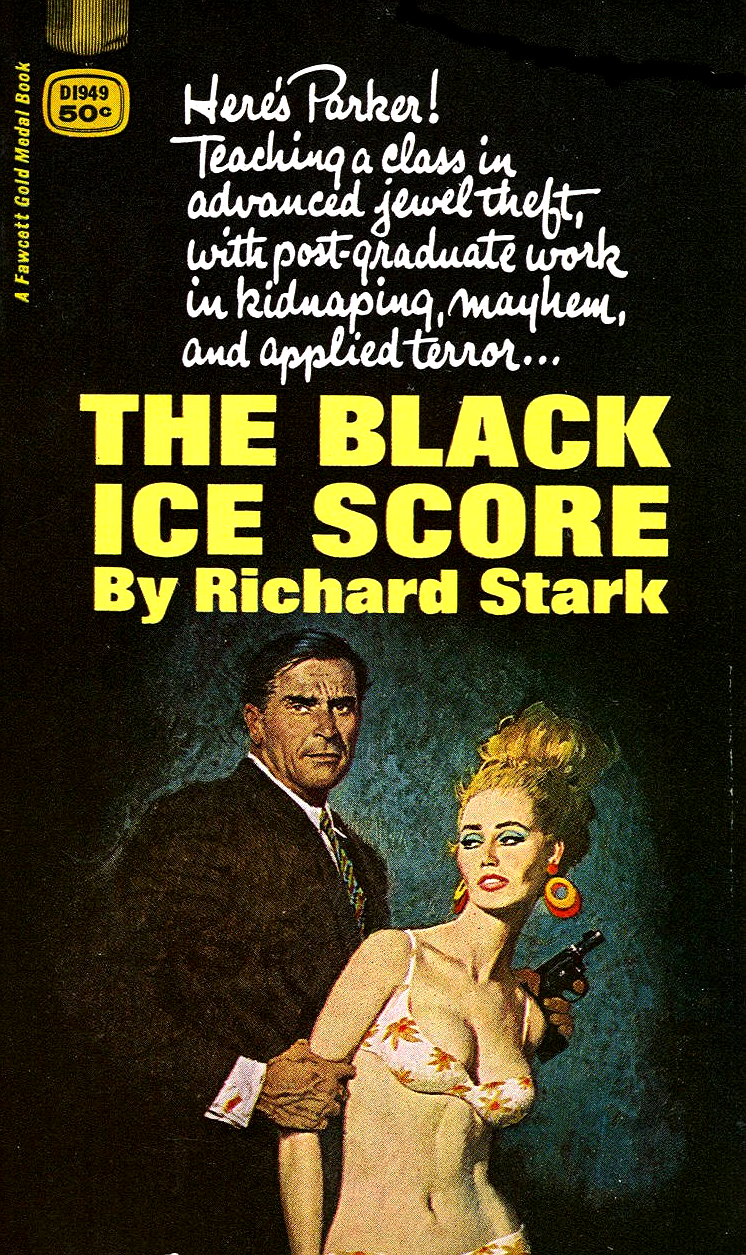
Published: 1968.
AKA: The Women Sharers.
Cover Artist: Robert McGinnis.
Publisher: Gold Medal Books.
Cover blurb: "Here's Parker! Teaching a class in advanced jewel theft, with post-graduate work in kidnapping, mayhem, and applied terror..."
Synopsis: Four amateurs plan a diamond heist in an attempt to save their nation, all with the help of a specialist: Parker.
Gallery:
Review:
The Black Ice Score (1968) is the 13th novel in Richard Stark’s Parker and Grofield series, and the third following the “something” score naming convention started by The Rare Coin Score. These titles are not incidental; the quartet of novels forming the halfway point of the series are all primarily concerned with showcasing these so-called scores, whereas previous entries had focused on the complications arising in and around Parker’s line of business but had not necessarily shown much of a regular day’s work. Here, at last, Parker shines as the consummate professional we know him to be.
It’s strange then that The Black Ice Score effectively only allows him half a job, Parker’s involvement ending at the planning stages, but then again, the novel’s true purpose appears to be conducting an experiment in characterisation. Having established Parker’s skills and personality up to this point, Stark seems curious to see how Parker fares in the face of more mundane human interaction.
Although not generally beloved by readers, The Black Ice Score is hardly a lacklustre effort. If anything, it contains some of the most tight and exciting action sequences Stark (or Westlake) had ever written. The best remembered parts of it are almost certainly Parker’s first person point-of-view chapter and the all-Black supporting cast of the novel, which was not only completely unprecedented for the time and the genre but bordering on radical and a clear sign of Stark’s avid interest in the kind of sociopolitical themes that would be explored again the following year in The Sour Lemon Score and The Blackbird.
The plot concerns a group of African diplomats from the fictional country of Dhaba attempting to recover the diamonds stolen by their country’s corrupt head of state in order to fund the ascension to power of their new president. Impoverished and practically nascent, Dhaba is in dire need of a change in leadership and the current order of things has also upset the former white ruling class. Three men representing this particular faction are after the diamonds too, but the trouble arrives twofold. The diplomats — Gonor, Formutesca, and Manado — need the help of a professional to pull off the heist, which is where Parker comes in, but they’d previously reached out to a thief named Hoskins, who’d been unable to help them but who is now also after the diamonds for his own purposes.
It’s certainly more politically heavy than the average Stark novel but the contours of it aren’t unfamiliar, he’d balanced a large number of moving parts many times before. The Parker novels are innately leftist in conception and execution, but nowhere else is that more apparent than in a story that shows Parker completely devoid of prejudice. It’s an intentional choice, rather than an unrealistic lack of racial dynamics. Stark still comments on American society at large, there are still bitter and half-ironic reminders of segregated hotels, and the fight for the diamonds is inherently a fight for Dhaba’s continued decolonization — and though Parker claims he’s got no interest in anybody’s politics, it’s plain to see whose side he’s on.
With Parker thrust back into the role of teacher, a typical crime fiction book of the 1960s might’ve been more interested in the differences between the white protagonist and his mentees but Stark portrays an easy rapport between Parker and Gonor, Formutesca, and Manado. Instead, interpersonal conflict comes from more unlikely sources.
Parker develops as a character over the entirety of the whole series. He reaches an expression of genuine and powerful sentiment by the time Butcher’s Moon comes around and he’s wistful and nostalgic as early as Slayground, but The Black Ice Score pushes him towards awkward, clumsy humanity. His dynamic with Claire resembles a partnership even less than it had in previous installments, and his sexless disinterest in her gives rise to an underlying tension that seems inescapable early in the book. Parker’s mind is elsewhere when Claire offers to put on a personal fashion show for him with the clothes she’d just bought, he lies to her about the two of them being in no danger, he’s disturbed by her presence on the job, they explicitly sleep in separate beds; and yet, he listens to her advice and seems invested in keeping her happy enough to stick around.
What Stark writes isn’t a relationship nor the kind of fling bestowed upon Grofield in his solo adventures, it’s something much stranger. Once Claire is kidnapped by the group intent on stealing the diamonds from Gonor and the rest, Parker sells them a story that delays them just enough to allow the heist to work out. “I told him I wanted to help him figure out a good plan because I didn't want him to go up against you people and lose. I wanted my woman back too much for that. That made sense to him, so he listened to me,” he says in the infamous first person point-of-view chapter. To Parker, affection for Claire seems to be just that: a likely story.
Parker’s first meeting with Hoskins also has an odd sense of pretense about it, an air of cloak and dagger. Parker goes to see him in the bar of the hotel he’s staying in with Claire, and the natural wariness of a meeting between two members of the criminal underworld seems to obscure some very compelling subtext. Recognizing Hoskins immediately despite having never met before, Parker spends a minute just observing him in the back bar mirror — “face handsome but weak, with a yellow-tan moustache, as though his dreams of glory included being a British air ace of the First World War.” When they do make contact, Parker thinks, “if Claire hadn’t been around on this trip, he would have agreed to meet Hoskins in the room,” and notes that Hoskins was “still smiling, as though he’d been complimented and was showing a pretty embarrassment.” These are all the motions of a very different kind of meeting, the song-and-dance of cruising, and in a novel that’s so focused on pushing Parker out of his comfort zone, the moment stands out plenty.
As does the experiment at the heart of The Black Ice Score. The story beneath the story is that of Parker expressing himself, of finding out what he sounds like when he does, of what these things say about him. When discussing the first person point-of-view chapter in an interview with Ed Gorman, Donald Westlake explained, “Once we have the fuel on board — and then, and then, and then — it’s nice to be able to try different things. Not to get digressive, but to give the story little extras. For instance, in one book I saw I had an opportunity, if I wanted, to tell one section in first person from Parker’s point of view. Since he isn’t someone who tends to want to tell other people anything, particularly anything unnecessary, I wondered if I could do it, what he would sound like, and would it turn out to be one of those false notes. In the event, it was fine.”
That particular chapter reveals much about Parker — social class and education being able to be inferred from speech patterns, his usual tendency to keep quiet making him sound stilted when he does need to talk — but the idea applies to everything the reader is privy to within the novel: his disinterest in Claire, his burgeoning friendship with Gonor’s group, where he’s placed within the racial dynamics of the story.
The novel’s commentary on race is conveyed primarily through its point of view chapters and the way the novel portrays the Black characters’ interactions with society. One of the earliest examples of this is when Gonor grimaces at the fact his men have to stay at a segregated motel despite their social status as diplomats working for the UN. Formutesca is amused at the irony of it, having come from a country in which his race is the majority. The idea of segregation is deeply beneath them, a thought which is also explored in his and Manado’s point of view chapters later.
Manado and Formutesca’s thoughts and feelings about their positions in a racially segregated America prove they’re some of Stark’s most complex supporting characters. Having attended university in the Midwest, Manado has a broader idea of what America is like when compared to the other two diplomats, remarking that being a Black man in this country might be “worth getting used to,” especially in the interest of serving Dhaba, despite the inherent sacrifice of dignity. Interestingly, experiencing the country’s ambivalence towards him makes him “more consciously a patriot about his homeland,” which serves as his motivation for the heist.
On the other hand, Formutesca has a more sardonic view of the world as he thinks back to hearing disparaging language white men used to describe two societal classes of Black men in Dhaba. The higher class men who had European training were still looked down upon by white men, and Formutesca sees these types even while working at the UN, remarking that he sees them as “bland and emasculated” as a result of the loss of their culture. He deeply resents this, thinking of it as depersonalization, a great offense in Stark’s world, where identity is number one.
Something within Parker seems to resonate with Formutesca and Manado finding themselves outsiders in American society. He’s oddly protective of Manado when he becomes injured, and trusts Formutesca to accompany him at the end of the novel. Although Parker doesn’t experience discrimination based on race alone, he is treated like a societal outsider in a broader sense, which accounts for his lack of prejudice, especially in this novel.
Written and released at a time when caricatures and stereotypes still inhabited the genre, The Black Ice Score is a decidedly progressive, sympathetic and layered exploration of identity across race and far from the mediocre effort it has often been dismissed as.